You're trying to source collars and are drowning in an alphabet soup of acronyms: BSCI1, ISO2, OEKO-TEX3. You risk choosing the wrong supplier and importing a product you can't sell.
The single most critical document you need is a tensile strength test report4. While other certifications are important for specific retailers or markets, this one report is the non-negotiable proof that your product is safe and won't fail, protecting your business from liability.

I've seen so many new partners get bogged down, creating massive checklists of every certification they've ever heard of. They think more logos mean a better supplier. But the reality is, many of these are optional or only required by specific big-box stores. They often miss the one thing that can truly sink their business overnight: a safety failure5. For products designed to restrain an animal, safety isn't just a feature; it's the entire point. That's why we have to start with proof of strength.
What international safety standards truly apply to dog collars?
You're searching for a single, global safety standard for dog collars like you'd find for electronics, but nothing exists. This lack of a clear rule leaves you exposed and uncertain.
The industry's de facto standard is proving performance through tensile strength testing. It's the only way to prove a collar is fit for its purpose and will not break under pressure.
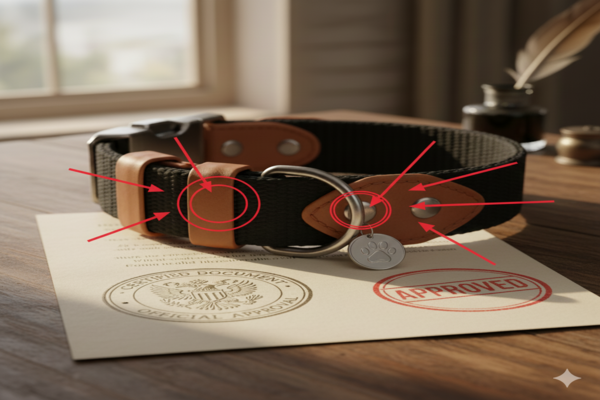
Unlike industries like children's toys or electronics, the pet products world doesn't have a single, government-mandated international safety standard. This is why you can't just ask if a collar is "certified." The question is meaningless without context. Instead, the responsibility falls on the brand (that's you) to ensure the product is "fit for purpose." The only way to prove this is with a tensile strength test. This test involves putting the collar on a machine that pulls it from both ends until it breaks. The machine measures the exact force at which the collar, buckle, or D-ring failed. I believe this is so important that we built our own testing lab. For every single order, we test the finished products and provide our partners with a formal report and even a video of the test being performed. This is your proof of due diligence.
| Dog Size Category | Typical Weight Range | Recommended Minimum Tensile Strength |
|---|---|---|
| Small | 5-20 lbs (2-9 kg) | At least 150 lbs (68 kg) |
| Medium | 20-50 lbs (9-23 kg) | At least 300 lbs (136 kg) |
| Large | 50-90 lbs (23-41 kg) | At least 500 lbs (227 kg) |
| Extra Large | 90+ lbs (41+ kg) | At least 700 lbs (318 kg) |
Why do major retailers require specific compliance certifications?
A huge retail partner asks for your factory's BSCI report, and your supplier doesn't have it. You risk losing a massive opportunity because of a document you don't fully understand.
These certifications (like BSCI or ISO 9001) are not about product safety. They are about managing the retailer's brand risk by verifying your factory's ethical labor practices and quality systems.

When a major retailer asks for these certifications, they are protecting themselves, not just checking product quality. They are terrified of a news story about their products being made in an unsafe factory or with unethical labor. These process-level certifications are their insurance policy. It's crucial to understand what they are and what they are not.
Process Certifications vs. Product Certifications
- BSCI (Business Social Compliance Initiative): This is an audit of our factory's social practices. It checks for things like fair wages, safe working conditions, and no child labor. It tells the retailer that their products are being made ethically.
- ISO 9001: This certifies that our factory has a documented and reliable quality management system. It means we have processes for everything from sourcing raw materials to final inspections. It gives the retailer confidence that we can produce a consistent product, order after order.
These are completely separate from product-specific tests like tensile strength or material safety. A factory can be BSCI compliant but still produce a weak collar. A truly great supplier will have both: strong process certifications and rigorous product testing.
How do material certifications like OEKO-TEX impact buyer trust?
Your marketing claims your collars are "non-toxic" and "safe for sensitive skin." But without proof, these are just empty words that savvy customers and competitors can easily challenge.
Material certifications like OEKO-TEX STANDARD 100 provide third-party verification that the textiles in your product are free from harmful substances. It turns your marketing claims into a verifiable fact, building immense trust.
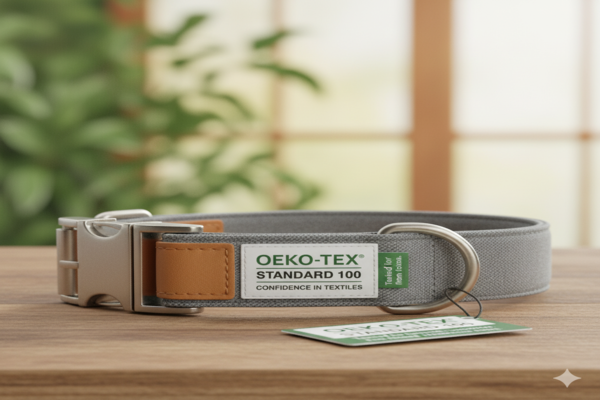
Today's pet owners treat their pets like family. They are increasingly concerned about the materials that are in constant contact with their dog's skin and fur. This is where material-specific certifications become a powerful marketing tool. The most recognized certification for textiles is OEKO-TEX STANDARD 100. When we source webbing or neoprene that is OEKO-TEX certified, it means that material has been tested and found to be free from a long list of substances known to be harmful to human (and pet) health. It’s a guarantee against things like allergenic dyes, pesticides, and heavy metals. For you, the procurement manager, this has two benefits. First, it reduces the risk of customer complaints about skin irritation. Second, and more importantly, it gives your brand a powerful story. You can confidently label your product as tested for harmful substances, setting you apart from cheap, uncertified competitors.
Which export markets have the most stringent testing requirements?
You're planning to expand your sales into the European Union. You assume the same product that sells in the US will be fine, but you're unaware of specific chemical regulations.
The European Union's REACH regulations6 are among the strictest in the world for chemical safety. If you plan to sell in the EU, you must ensure your supplier can provide proof that your products comply with these complex rules.
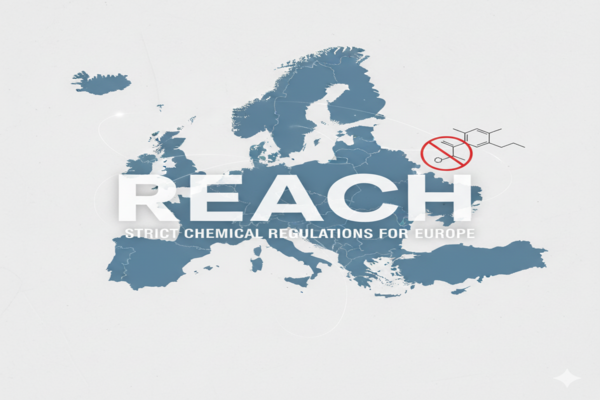
Different markets have different obsessions. While the US market is very focused on performance and durability, the European Union is intensely focused on chemical safety. The guiding regulation here is called REACH (Registration, Evaluation, Authorisation and Restriction of Chemicals). REACH is a massive and complex piece of legislation that restricts the use of thousands of different chemical substances in consumer products. For dog collars, this is particularly relevant for the dyes used in webbing, the plasticizers in PVC parts, and the coatings on metal hardware. A product that is perfectly fine for the US market could be stopped at a European port if it's found to contain a restricted substance, even in tiny amounts. A good supplier who exports globally will already be familiar with REACH. They should be able to provide you with test reports from a third-party lab (like SGS or Intertek) confirming that the materials used in your collars are REACH-compliant. Don't just take their word for it; always ask for the report.
Conclusion
While the world of certifications seems complex, your focus should be clear. Prioritize the non-negotiable tensile strength report to ensure safety. Then, layer on process (BSCI, ISO) and material (OEKO-TEX, REACH) certifications based on the demands of your target retailers and export markets. This approach protects your business and builds trust.
Footnote:
Learn how BSCI certification can protect your brand's reputation and ensure ethical practices. ↩
Understanding ISO certification helps ensure your supplier meets quality management standards, protecting your brand's reputation. ↩
Explore this link to understand how OEKO-TEX certification enhances product safety and builds consumer trust in pet products. ↩
Understanding this report is crucial for ensuring product safety and avoiding liability. ↩
Learn why safety failures can be catastrophic for your business and how to prevent them. ↩
Understanding REACH is essential for exporting to the EU and ensuring chemical safety. ↩