I recently walked through a major pet retail trade show in Nuremberg.
Every booth had the basics: flat nylon collars in red, blue, and black. They were cheap, standard, and completely undifferentiated.
Then I stopped at a booth that was swamped with buyers. They weren't selling simple collars; they were selling "security solutions" for sighthounds and rescue dogs. They were selling Martingales.
For a Procurement Manager or business owner, the Martingale collar1 represents a pivotal shift. It moves your product line from "generic accessory" to "vital safety tool."
If you are just filling shelves with standard buckles, you are leaving money—and trust—on the table.
Here is why the Martingale is the single most strategic addition you can make to your inventory this quarter.
The Core Function: How a Martingale Collar Prevents "Houdini" Dogs
Most people think a collar is just a place to hang an ID tag.
That works fine until a customer’s dog gets spooked by a car backfire, backs out of their flat collar, and bolts into traffic.
When that happens, the customer blames the gear. And they blame the brand that sold it to them.
I explain the Martingale mechanism to my clients like this: Active Safety2.
Unlike a standard collar, which has a static diameter, the Martingale features a two-loop system.
- The Adjustable Loop: Fits around the dog’s neck like a normal collar.
- The Control Loop: The leash attaches here. When tension is applied, this loop pulls the larger loop taut.
It’s simple physics. The collar tightens just enough to prevent the dog's head from slipping through, but—and this is critical—it stops tightening before it can choke the dog.
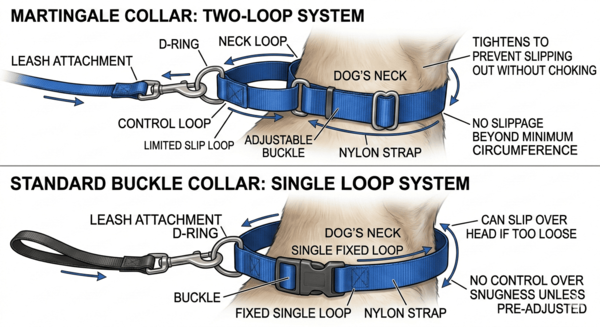
Why this matters for your defect rate: In manufacturing, function dictates quality. Because the Control Loop bears the brunt of the force, we reinforce these stress points with heavy-duty bar-tack stitching. At BoonPets, we test our D-rings to withstand force multiples higher than the dog's weight.
If a supplier tries to sell you Martingales with single-stitch seams to save a few cents, run.
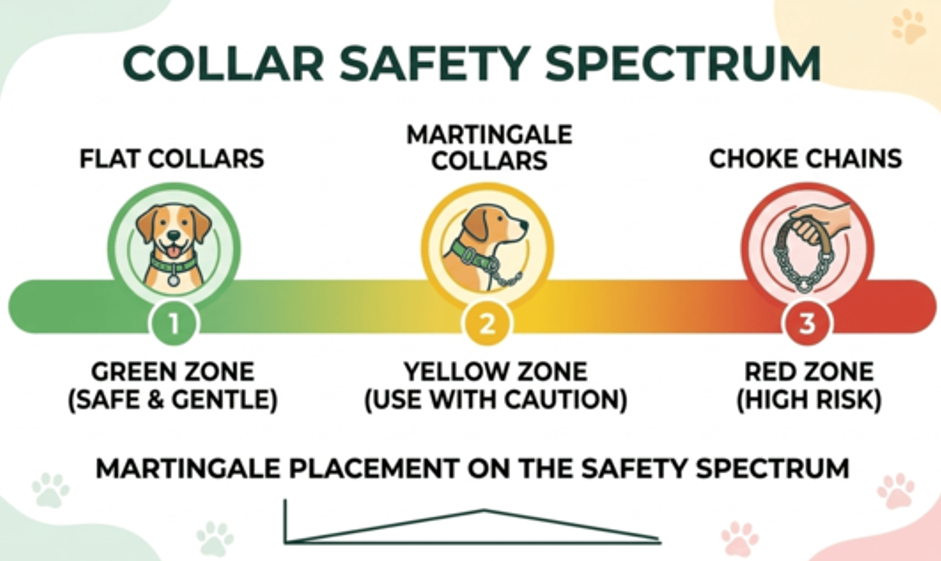
Martingale vs. Other Collars: A Head-to-Head Comparison
Buyers often ask me, "Can't I just stock slip leads or choke chains?"
You can. But you’re limiting your market to old-school trainers and losing the modern, welfare-conscious pet parent.
The market has shifted energetically toward positive reinforcement. The Martingale sits in the "Goldilocks" zone—effective enough for control, gentle enough for daily wear.
Here is the framework I use when advising clients on their catalog mix:
| Feature | Standard Flat Collar | Choke/Check Chain | Martingale Collar |
|---|---|---|---|
| Primary Function | ID Holding / Casual Walks | Correction / Training | Escape Prevention / Gentle Control |
| Safety Risk | High (Back-out risk) | High (Trachea damage) | Low (Limited constriction) |
| Ideal Customer | Every dog owner | Professional trainers | Sighthound owners, Rescues, Anxious Dogs |
| Target Market Sentiment | Neutral | Negative (perceived as harsh) | Positive (perceived as humane) |
The Verdict: For mass retail and B2B distribution, the Martingale offers the highest safety profile with the lowest liability risk. It appeals to the widest range of "serious" dog owners.
Who Truly Needs a Martingale Collar? Identifying the Ideal Dog and Owner
Understanding the end-user is the only way to write specs that sell.
During a recent project with a distributor in the UK, we identified three distinct consumer avatars that drove 80% of their Martingale sales.
1. The Sighthound Owner (Greyhounds, Whippets)
These dogs have necks wider than their heads. A standard buckle collar slides right off. For this demographic, a Martingale isn't an option; it's a necessity.
- Production Note: We often use wider webbing (1.5" to 2") for this group to disperse pressure over a larger surface area.
2. The Rescue Adopter3
Rescue dogs are often flight risks. They are skittish and prone to panicking on walks. Shelters often mandate Martingale collars before allowing an adoption.
- Production Note: Durability is key here. These owners need absolute assurance that the hardware won't fail during a panic attack.
3. The "Puller" in Training
This is the frustration buyer. Their dog pulls, but they refuse to use prong collars. They want a solution that helps communicate with the dog without causing pain.
By targeting these specific groups in your marketing, you aren't just selling a nylon strap. You are selling a solution to a specific biological or behavioral problem.
Beyond Pet Owners: Why Martingale Collars Are a Smart Choice for Your Business
Let’s talk numbers and strategy.
Why should a Business Owner or Procurement Manager care about a specific collar type?
Because generic products kill margins.
When you import standard collars, you are competing with Amazon Basics. It is a race to the bottom on price. Martingale collars, however, allow for premium positioning.
The Customization Advantage
I’ve found that Martingales offer more "real estate" for design differentiation than almost any other product.
- Webbing: The dual-loop structure allows for two-tone colorways (e.g., a patterned main loop with a solid control loop).
- Hardware: This is where we win. At BoonPets, we offer finishes like electrophoresis black, rose gold, and pearl nickel.
A Factory Floor Observation: I was walking our assembly line last month, watching the plating inspection for a batch of gunmetal D-rings. A competitor might accept a tiny bubble in the finish. We reject it. Why? because premium buyers pay for aesthetics as much as safety.
If you are sourcing Martingales, leverage this customization. Don't just order black nylon. Order a custom Jacquard weave with pearl nickel hardware. Create a brand signature.
The "Humane" Market Trend
Data from the American Pet Products Association (APPA) consistently shows a rise in spending on "premium" and "health/wellness" categories.
The Martingale aligns perfectly with the humane training trend4. By stocking this, you position your brand as an authority on animal welfare, not just a commodity seller.
The Next Step in Training: Using Martingales for More Than Just Safety
Finally, to truly sell this product, you need to educate your customer.
Most end-users use Martingales incorrectly. They let them hang too loose, neutralizing the safety benefit.
If you are a retailer or distributor, include this guide with your product. It adds massive value and reduces returns claiming the product "didn't work."
The 3-Step Fit Check:
- The Ear Check: With the dog standing, pull the control loop up. The two metal rings should meet without the collar choking the dog. It should be just tight enough to not slip over the ears.
- The Resting Gap: When the leash is loose, there should be about two fingers' width of space between the collar and the neck.
- The Dead Ring: always attach the leash to the D-ring on the control loop (the "live" ring). Never attach it to the side rings.
By providing this level of detail, you transform from a vendor into a partner in their dog's safety.
Conclusion
The Martingale collar is more than a piece of nylon.
For the dog owner, it is peace of mind. For the dog, it is safety without pain. For you—the buyer or business owner—it is a high-retention, high-value asset that separates your brand from the generic noise.
At BoonPets, we don’t just manufacture these collars; we engineer them to withstand the realities of the market. From custom hardware finishes to rigorous tension testing, we build products that let you sleep well at night.
If you are ready to upgrade your supply chain with products that actually build brand equity, I’m here to help. Strategies are free; execution is where we thrive.

Footnote:
Explore the advantages of Martingale collars for dog safety and training, ensuring your pet's well-being. ↩
Understand the concept of Active Safety in dog collars and its importance for pet owners. ↩
Learn why shelters recommend Martingale collars for rescue dogs to ensure their safety. ↩
Understand the humane training trend and how it influences pet product choices among consumers. ↩